

European experiential al maximo
This is how much Oktoberfest in Munich costs (2025)
How Much Should You Budget for Oktoberfest? From flights to festival snacks, here’s what you’ll spend at Oktoberfest in Munich – plus what I wish I’d known before I went.

I’ve never had any interest in going to Oktoberfest. I always thought it was a gimmicky, messy party for Americans to drink way too much beer and co-opt a 100s-year-old culture with Amazon costumes. So when my brother’s friend group invited me a year ago it didn’t even occur to me that I would end up going.
A month before they left I had a change of heart and got a ticket to Europe. As it turns out, the Oktoberfest that I had created in my mind couldn’t have been farther from the reality of the event – a culturally rich, historically nuanced, authentic experience; especially if you do it right.
We arrived to find mostly Bavarian Germans celebrating the 3-weekend holiday with great beer and endless entertainment. And while it is largely a drinking event, it was not the college frat party that I had expected. It was more a wholesome revelry.
This is how much Oktoberfest in Munich costs (2025)
In this article, I will take you through my 3-day “weekend” at Oktoberfest in 2024, relaying exactly how much everything cost (yes, I kept track), so you can understand 1) what the experience is like, 2) how to navigate the planning process, and 3) how much it costs to do Oktoberfest. The exchange rate was more or less the same last year as it is now, so you can take these numbers as a proxy for current prices.
Where is Oktoberfest: At the Theresienwiese(often just called the Wiesn by locals), in Munich, the capital of the Bavarian region of Germany
Dates: Late September to the first Sunday in October (2025 dates: Sept 20 – Oct 5)
Currency: Euro (€); 1€ to $0.85 USD (Quick math: 1€ to $1 – although this is shitty because you’re underestimating your spending by 15%)
But how much does it really cost?: Expect to spend $12 per stein (big beer), $10–25 per meal, and $300+ per night for hotels during peak weekends
Language: German (but most workers at Oktoberfest speak basic English)
Airport: Munich International Airport (MUC)
Time Zone: Central European Summer Time (CEST); +6 to +9 hours ahead of U.S. time zones
Transportation: U-Bahn, S-Bahn, trams, and buses – easy access to Theresienwiese, no car needed
Best Time to Visit: Midweek during the first week of Oktoberfest (fewer crowds, better deals)
Weather & Altitude: Average highs: 55–65°F (13–18°C); cool mornings & chilly nights – bring layers
Typical Foods: Oktoberfest beer. German beers served in steins. Roast chicken (hendl), pork knuckle (schweinshaxe), giant pretzels, weisswurst, apple strudel, and lots of beer (in 1-liter Ma)
Upfront costs
Total cost: €187 ($208.02)
Flights: 75,000 Lufthansa round-trip + $75 in taxes
Hotels/lodging: We stayed at the Hampton by Hilton Munich City West for 147,000 Hilton points

Tracht: Tracht refers to the traditional clothing worn in Bavaria and other Alpine regions of Germany. Their origins date back a while, but we all know them as the leather pants and suspenders (lederhosen) worn by men and risqu or androgynous women, and the busty milkmaid dress and corset (the dirndl) worn by women and popularized in The States by the voluptuous St. Pauli Girl.
At first I was set on buying our tracht in Bavaria. Who wants to show up to a cultural gem like Oktoberfest in an Amazon dirndl? But after doing a little research I realized that that level of authenticity was going to run me about $500. I needed a solve and by this time we were 10 days out.
Fortunately my friend Natalie is a genius and found Held Over, a German-owned vintage shop in San Francisco. We all found our outfits there. Generally the dirndls were $60 but I found one with a broken zipper for $10. I figured I would superglue it or something. My bodice blouse was $32 so I was feeling pretty good about myself. But when my brother decided against the gay lederhosen short shorts he had found I tried them on I realized I might want to go with a more androgynous outfit (the milkmaid look really doesn’t fit my masculine personality). So I bought it all. The lederhosen were $55, and I ordered Dockers suspenders online for $15.
See here for info about where those Oktoberfest outfits come from and where you should get yours.
Day 1 - Monday
Total cost: €168.48 ($184.42)
Bus from Slovenia
The trip started with a 9:41 AM Flixbus bus ride. The bus operators, visibly and audibly shocked by my 32 kilos (70 lb) bag, charged us €21.99 ($24.06) extra. In their defense, that is the standard charge per bag, as written on the ticket, and they could have charged us for our second overweight bag but didn’t.
The tickets were €22.99 ($25.16) and we paid an extra €10 ($10.94) for the “panoramic seating,” which is the front of the bus where you can see out of the giant windows. But when we got on the bus our row number didn’t exist. Apparently they changed buses and scrapped the assigned seating. In the end we just asked if we could sit in the front anyway, which is normally reserved for the bus operators.
Pro tip: always get assigned seating when traveling by bus or train in Europe, otherwise you get kicked out of your seat at every stop by the more seasoned travelers who did choose assigned seating if you’re in their seat. Our friends traveling from the Berlin marathon to Oktoberfest with 2 million other people were standing up and sitting on the floor for the entire 6-hour train ride.
The bus ride was stunning, especially through Salzberg. We passed a castle and just a bunch of general Sound of Music-level Alps scenery. About an hour into the trip the bus drivers decided to put the shades down so that our panoramic view became a restricted view. I would still recommend these seats, though, as they were much more spacious than the rest of the bus, and had a tiny table that didn’t really work as a desk but you could set your drinks and snacks on them.

Landzeit Gourmet Market & Restaurant
We stopped midway at Landzeit Gourmet Market & Restaurant – the Austrian answer to the American truck stop, which is a super posh boutique buffet-style cafe, with amenities like olive oil on tap. It was in a valley in the middle of the Alps and it was breathtaking, but that beauty comes at a cost – €21.80 ($23.84) for a plate of pasta marinara, for example. We got the tiny bowl of soup and threw some green onions on top for €8.31 ($9.09) and called it a day. Honestly, it was pretty good.


Pro tip: Wild Bean Cafe is hidden behind Landzeit (shares a wall) and they have sandwiches for €4.49 ($4.91), and other snacks that aren’t exorbitantly priced.

Dinner at Klinglwirt
For dinner we met up with the party of 12 coming from Berlin and our friend Davy, who used to live in Germany, so knows the language and culture, took us to an authentic Bavarian, no-frills spot called Klinglwirt.
We started off the meal with a healthy serving of dunkel beer. I thought I had found my favorite German beer brand but it turns out it just means “dark” in German. My husband and I split the Spinat-Kasespatzle (the house special: a soft egg noodle with spinach and cheese, topped with caramelized onions) and the Vienna-style Schnitzel with pork, cranberries, and fried potatoes. The tab came to €48 ($52.53) per person, split evenly.


Hofbrauhaus Manchen (The Royal Brewery House of Munich)
To prepare ourselves for Oktoberfest Davy took us to Hofbrauhaus Manchen (The Royal Brewery House of Munich). This is the famous Oktoberfest pregame and afterparty spot where the Germans drink the 1-liter dimpled glass beer stein and get drunk, sing German chants, cheers each other over and over, and bang their fists on the tables until their beer spills and the waiters tell them to stop. According to Davy they have a name for these antics and it’s ‘Stammtisch.’ Hofbrauhaus Manchen at 11:30 PM was quite a diverse crowd, age-wise. I saw everything from 1-year-old baby to 80-year-old men arm wrestling.
I had been fantasizing about a pretzel with cheese since we bought our tickets to Oktoberfest and, unfortunately, it did disappoint. I had been long awaiting a soft, salty warm piece of lye-dipped bread with that gooey beer cheese that you used to get at the mall in the 90s, but it was at this moment that I realized that I had been indoctrinated by Wetzel’s Pretzels and that’s not the reality of the European counterpart. This pretzel was cold, hard, and cheeseless. Financially, it only set me back €5.60 ($6.13), but you can’t quantify the emotional damage one endures from a trauma like this.

Davy ordered a round of the Hofbrau Oktoberfest Beer – €10.80 ($11.82) each, and so large that I could only drink half of it. Between the beer and the busty women in dirndls serving them, I did move on from the pretzel incident.
We stayed at the Leonardo Hotel Muenchen City West. It’s 147,000 Hilton points or $364. We found points were useful for Oktoberfest. The hotel was great, nothing uber-luxe but next to the train station that was like 7 minutes from the Oktoberfest grounds.
Check out other hotels for Oktoberfest
Day 2 - Tuesday
Total cost: €177.19 ($193.88)

Today was the big day. Still completely unsure how it was going to go (Did we have a tent? Would the weather hold up? Would the Bavarians accept us in our American-bought tracht?), we put on our garb and headed to the festival.
The train ride was 2 stops from our hotel and €3.90 ($4.27) – under the honor system with no scanning or ticket checker. Germans are rule-followers.
My husband got patted down outside of the gate because he looks Bavarian and the real-deal lederhosen actually have an interior knife holder that the Germans have been known to bring into the carnival.
I called Josef, a friend of a friend who said he would show us around the festival. I wasn’t sure he existed until I saw him in the flesh outside of the gate, in very dapper, non-costumey tracht, made from deer skin that he killed himself (the pinnacle of Bavarianism).


The origin of Oktoberfest
Josef downloaded us on the history of Oktoberfest: In the early 19th century a Prince Ludwig of Bavaria was getting married and decided he wanted everyone in the country to celebrate with him, so he threw a version of the reception for the common folk: the carnival that we now call Oktoberfest. The wedding was in October (the 12th), but over the years the festivities moved into September, when the weather is nicer – the reason for the confusion over why Oktoberfest is in September. According to Josef, the original dress code was formal (like a wedding), and people only started dressing in traditional Bavarian garb in the last 15 or so years.
Augustiner Brau tent
Our first stop was a quick duck into the Augustiner Brau tent to see the band. We went through a little trap door at the base of the bandshell and met the band – Josef’s friends. It turns out Josef is a retired Bavarian anti-terrorist SWAT team officer and good friends with the owners and managers of all the tents, as well as the bands, and generally everyone at Oktoberfest.

Schottenhamel Festhalle tent
Next was lunch. Josef got us 2 tables at the Schottenhamel Festhalle tent. Our group of 14 split into 2 tables, one at which a little old German lady was sitting. We never got her name but we’ll call her Gertrud. Gertrud spoke no English but managed to engage in the discussion as if she was fluent, periodically erupting in wild laughter, chanting in German, and initiating group cheers from time to time. She was a bit wild and I think she wanted to coax us into some Stammtischism.
As our friend Neil was taking a picture of his face in a pretzel Gertrud grabbed the pretzel mid-picture and tore it in 3 pieces, laughing hysterically. She never ordered any food, but she ate as if she did. When our friend Elaine returned from the restroom to find her chicken dish missing and asked where it was, Gertrud reached into her purse and pulled out the chicken in a plastic bag. She told us in German that the only way to make friends is to joke and share things, and that’s exactly what she did. She has us laughing hysterically for two hours straight. Oktoberfest was off to a great start


We paid €70 ($76.61) each for 2 very large (maybe too large) beers, lunch, and dessert. The food was great. My husband and I split Nurnberger Rostbratwurst (with sauerkraut and mustard) and the house special. Then we got the Rohrnudeln, kaiserschmarrn and the Frische Auszogne for dessert.
I have no idea what these are but you can see from the picture that they were heavenly.

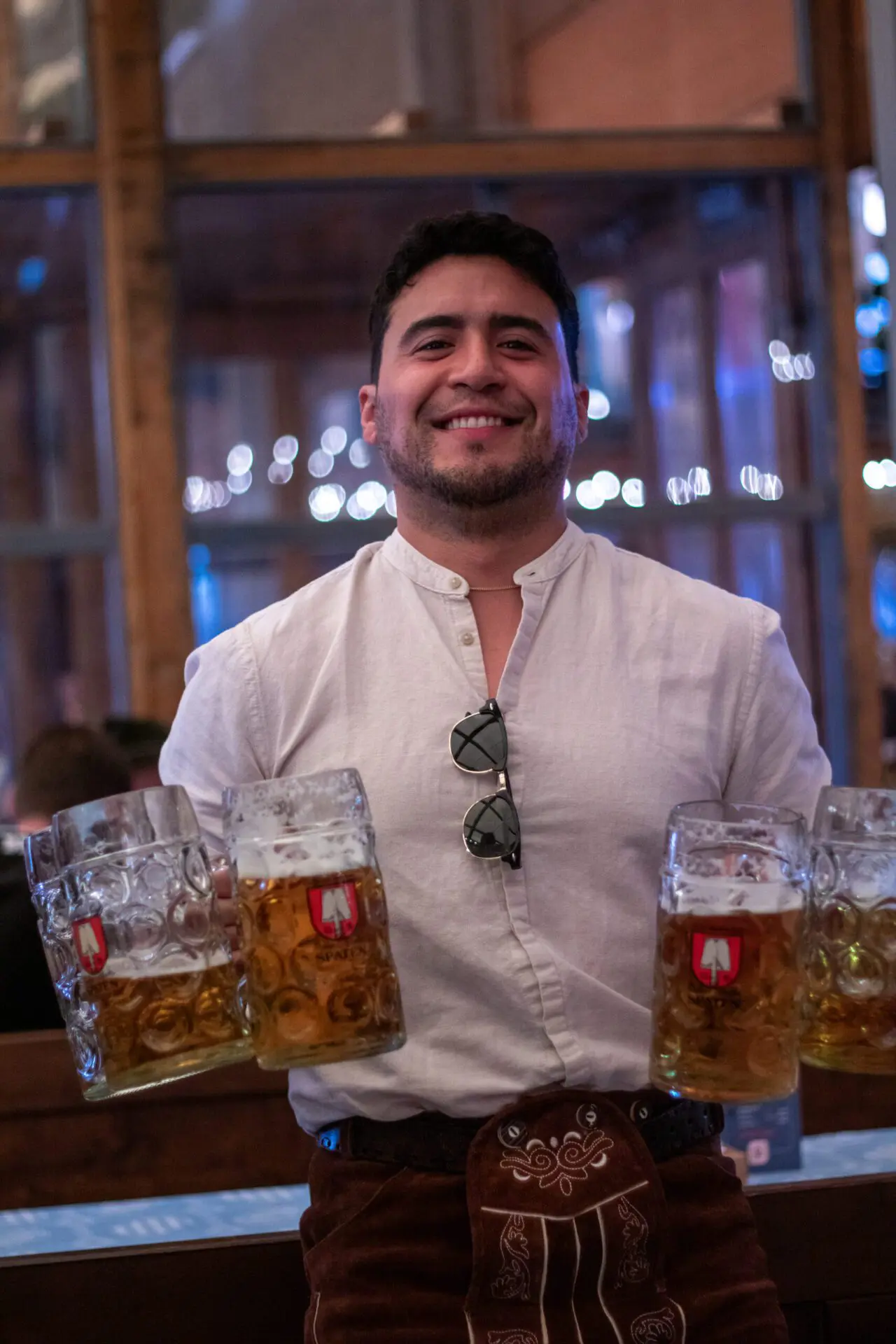
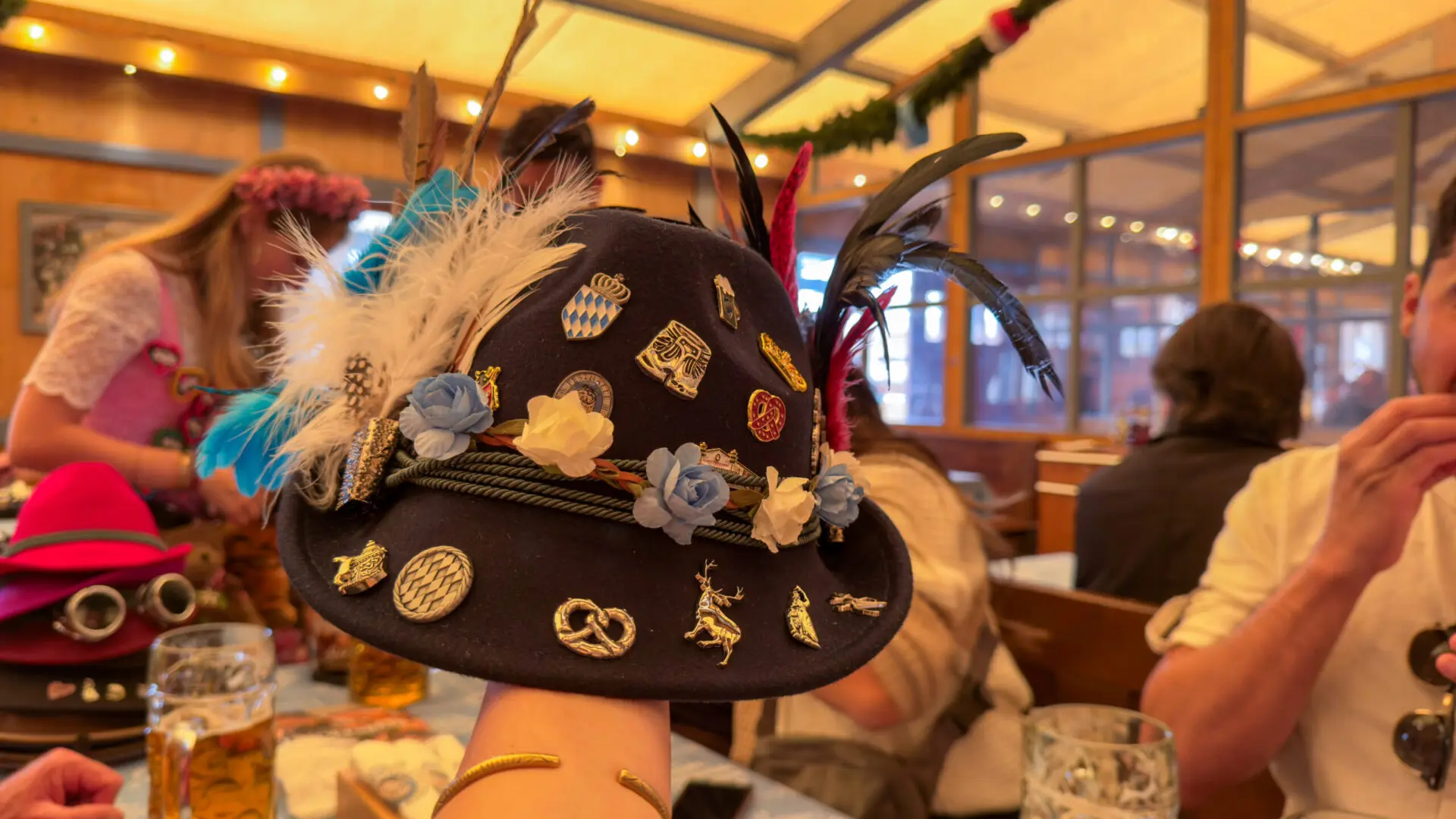
My husband bought a Tirolerhut hat for €25 ($27.37) and the feather for €12 ($13.13) (which he wore every day until we got back to the US), and Gertrud initiated a Masskrugtragen competition (you know when you see the Oktoberfest waiters carrying a million beers at one time?).
Our record was 6, a tie held by Ms. Connie Lii of Cupertino and Bernardo Sotillo of Maracaibo, Venezuela.
The world record is 31, held by Oliver Strampfel from Germany.
After lunch Gertrud peer pressured us into chugging the second beer. It was too much, it’s not in our blood. My brother-in-law was literally crying (pictured, below right).

All this gluttony on food and light beer probably saved us, because had we been drinking cocktails and eating something more dainty some of us likely would have ended the night much earlier.
Hacker-Festzelt tent
At 2:30 Josef told us it was time for our behind-the-scenes tour of the Hacker-Festzelt tent – one of the most famous – very difficult to get a table reservation there and almost impossible to get a tour. We went around and the manager showed us the kitchen, told us how the security worked (basically they have undercover cops making sure perverted drunk men, or “finger people,” as he called it, aren’t bother the girls), as well as a beer control room that looked and felt like an underground WWII bunker monitoring war operations but is literally just for making sure that the beer is flowing like the salmon of the Capistrano.


It was also at the Hacker tent that someone introduced us to the illicit-sounding but benign substance, “Bavarian cocaine.” It’s actually just snuff tobacco that people sniff through their noses and despite the nickname, it is entirely legal and has no connection to actual cocaine. It’s a little party trick at Oktoberfest beer halls and a tradition in Bavarian culture.


The Carnival


The Toboggan game
We put Natalie on time out and left the beer tents for the carnival. We hit up the toboggan game where you hop onto a conveyor belt to pretty dangerously try maintaining your balance while being thrusted up 40 feet into the air. The cost is €6 ($6.57) but comes with the potential for a German hospital bill.


Teufelsrad – the Devil’s Wheel
My all-time favorite game at Oktoberfest was the Teufelsrad, or Devil’s Wheel. It’s a huge spinning platform where different random groups are called out (men with hats, kids under 10, women wearing braids). They run up to the platform (you want to get as close to the center as possible), and it starts spinning. 90% of the people fall off immediately but the last few people are the most entertaining because the operators literally lasso them while a ball simultaneously rolls back and forth through the air on a rope, hitting them in the head, and while they try pushing each other off. Most entertaining thing I’ve seen in my life for only €5 ($5.48).
Rischart’s Cafe Kaiserschmarrn – the dessert tent
After some good ol’ fashion carnival Josef took us to Rischart’s Cafe Kaiserschmarrn – the dessert tent and Oktoberfest’s only catwalk. The music was very American pop and LatinX and so the gays and the Latinos were having a blast. We got a round of Porn Stars (martinis, not humans) and Aperol spritzes and we split the three desserts that they had on the menu. The tab was €2,039 ($2,232.91), which seemed very high. Josef talked to the manager and they told us they accidentally added an extra zero in there and that the real tab was actually €239 ($261.93) or €14.5 ($15.89) per person, so they fixed it and gave us a glass of champagne.


Oide Wiesn – “old grass”
At the end of the night Josef showed us what I would consider the gold standard Bavarian Oktoberfest hack. Oide Wiesn (“old grass” in English) is the nostalgic section of Oktoberfest, created in 2010 to celebrate the 200th anniversary of the festival. Everything there is kind of ‘analog’ and focuses on the traditional aspects of the festival and the nostalgic Bavarian culture.
The analog bowling alley had bowling pins with literal ropes that the guys used to hoist the pins up after they’re knocked over. The “Motodrom”, also known as the Wall of Death, isa vintage motorcycle stunt show where daredevil riders race around the vertical wooden walls of a circular arena, like a silo. defying gravity and thrilling crowds above. Apparently many of the riders are from families who have been doing this for generations.
It costs €4 ($4.45) to get in, but the point of that cost is to provide a barrier to entry, just enough so that people go there intentionally, rather than stumbling into it. But – once you get in everything is actually cheaper.
Oide Wiesn has historic rides that are replicas of early 20th-century attractions, and are beautifully clanky, giving it an old-world charm. It has smaller tents, German folk music, and a lot of traditional Bavarian dancing. The beer is brewed using more traditional recipes, and the vibe is quieter and more family-friendly. It’s really beautiful and authentic – please don’t go in there with a motley crew.


While this part of the night was peaceful, what happened after was chaotic. It started monsoon raining, just as the festival was closing and we all got separated. I was wet, a little drunk, and my phone was on 1% by the time my friends finally found me. We scrambled onto some train, fighting the crowds just as the rest of our phones died and we had to ask the nice Germans for help to figure out which stop to get off on. My brother-in-law threw up. I don’t think we paid for the train ride. My life flashed before my eyes. But I made it to see another day in Bavaria.


Day 3 - Wednesday
Total cost: €199.80 ($218.47)
We spent the next day exploring the non-carnival version of Munich, in our tracht (not gonna waste good lederhosen). Today though, I switched it up to the more feminine dirndl.

Viktualienmarkt – dating back to 1807
We had breakfast at Viktualienmarkt – Munich’s most famous and very chic open-air market (dating back to 1807). It’s one of those farmer’s-market-turned-bougie-foodie-haven places. It has a cute little biergarten with live music.
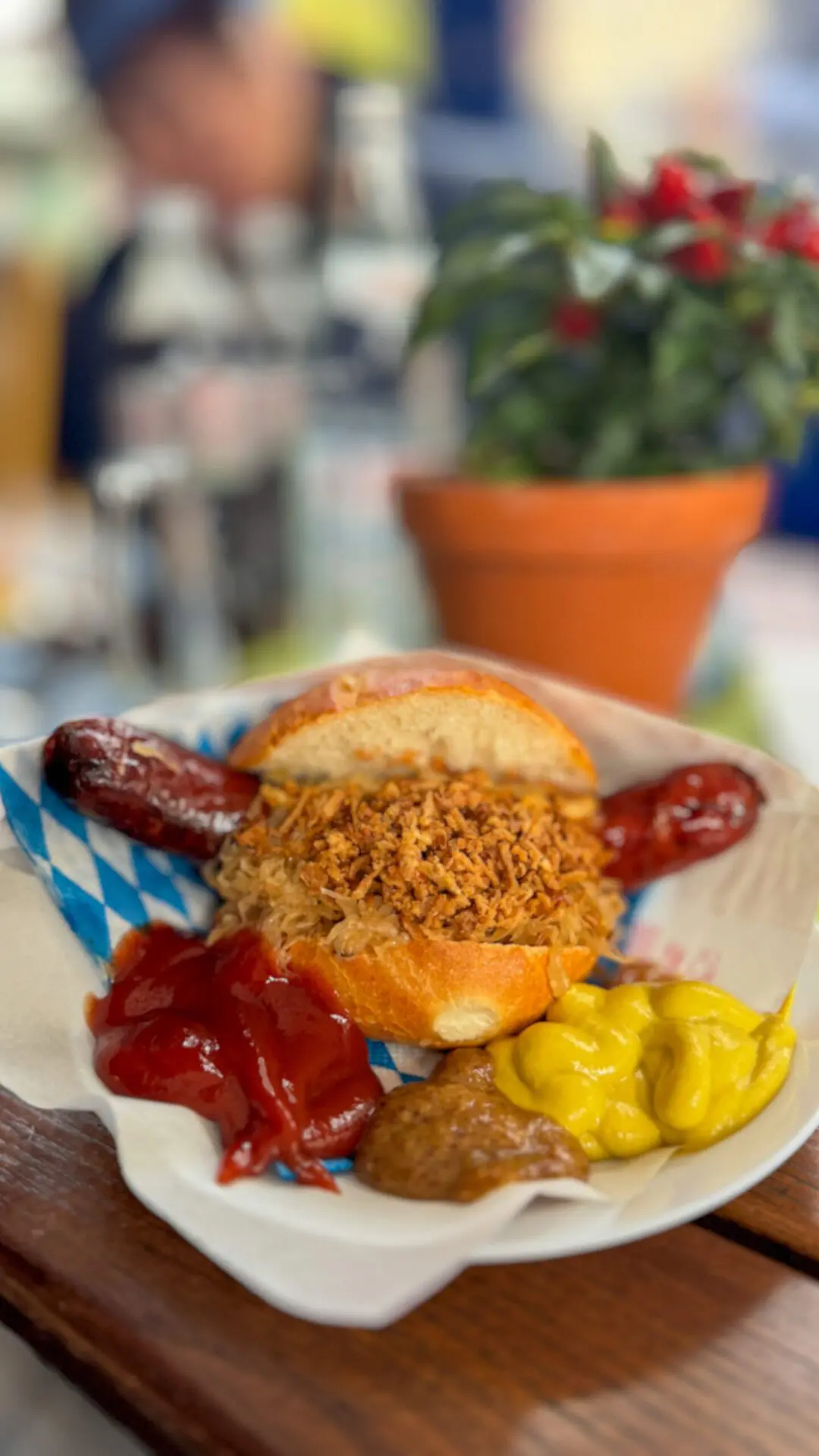
For our first course we dined at Kleiner Ochs’nbrater, a cute counter-service outdoor seating spot. We got a bratwurst that came in the shape of a bull (love it!) for €8.80 ($9.63) and a Brezen beer for €1.40 ($1.53) (so cheap!).


Our second course was a picnic. We have a few dairy-obsessed people in our group and they bought a cute little spread of very strong-smelling cheeses and some wine, and for the small price of €26.57 ($29.10) the 12 of us dined on 5 goat cheeses, some tomatoes, and basil – on a bench, like the San Francisco people that we are. We drank an Altanzno wine from the Spanische Delikancan for €12 ($13.16).


For dessert we shared a small cup of €2.50 ($2.74) from Zio Santo, who is apparently the ice cream king of Munich. Like, officially, in the newspaper.
Shopping around
On our walk we had multiple groups of tourists (and even some Germans) ask to take pictures with my husband, which confused us at first. When we finally asked, one group told us their Bavarian tour guide pointed them to my husband and said, “This guy’s the real deal.” As in a real Bavarian man. He’s not. He just looks very German and wears lederhosen regularly now.
Then we stumbled into a department store where the owners started speaking German to him. When he answered in English they asked “why are you speaking English!”
In the store we found the most beautiful pair of shoes we’ve ever seen. They’re designer sneakers from an Italian brand called Kiton, but they resemble men’s dress shoes. Comfort and style. They were €590 ($647.12) and fortunately, they didn’t have his size because after that second Augustiner lager he would have bought them.


Next stop: a little history. The Residenz was the primary residence of the Wittelsbach dynasty. In spite of its name, it’s definitely a palace (Germans are so modest). It houses a lot of art, historical architecture, and very expensive jewelry. Entry was €9 ($9.88) for just the museum, but the entire experience would be €23 ($25.26).


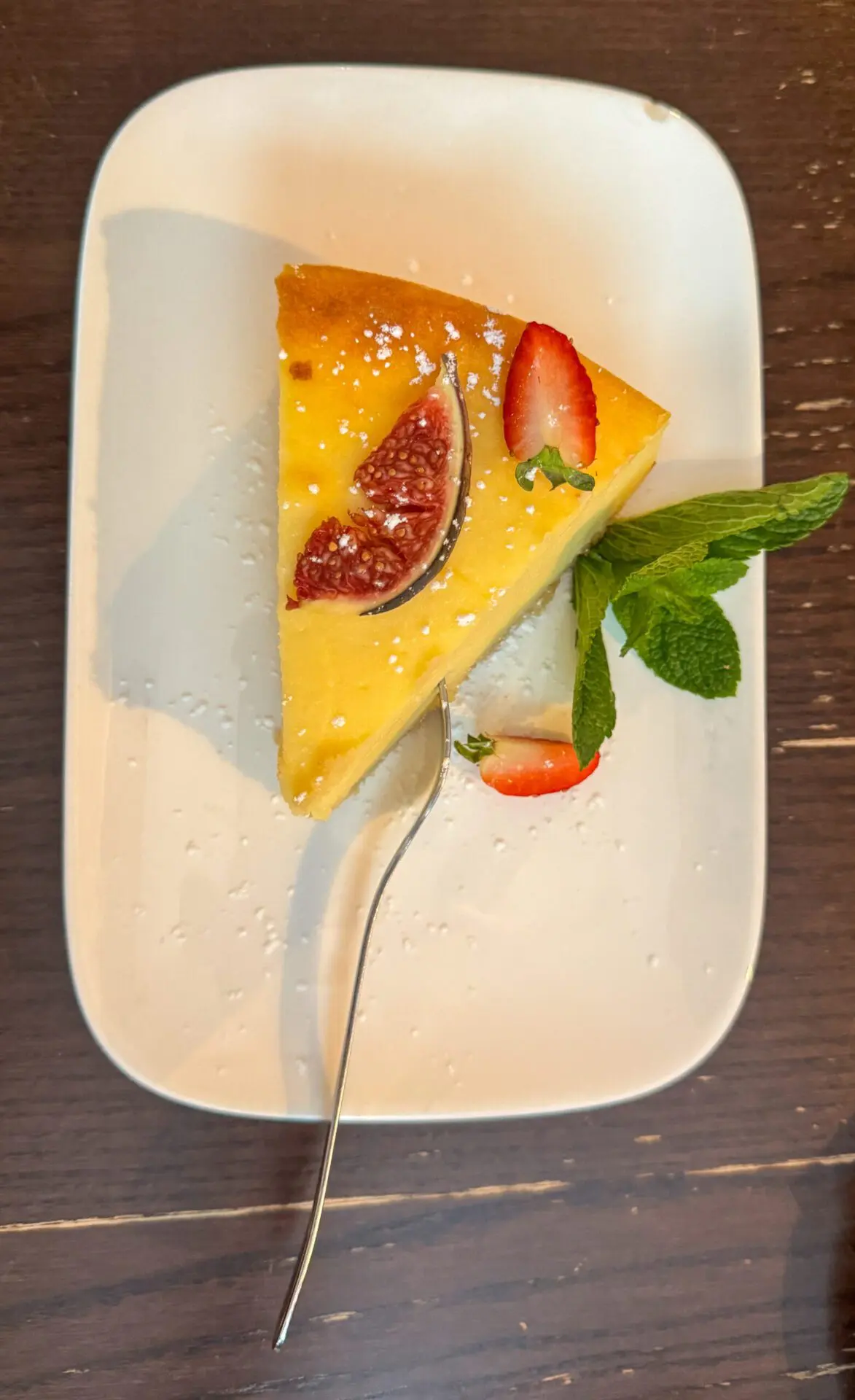
After the Residenz we were pretty famished, so we went for a 3rd course at a random place we walked by that ended up being a great stop. Caffe Vinca is cozy and welcoming and we loved the staff, the food, and the drinks. I got the truffle pasta for €18.90 ($20.77), a cappuccino for €3.80 ($4.18), and a classic dessert thing for €13.90 ($15.27).


We walked off the 3rd course through the English Garden, which is one of the largest urban parks in the world. Everyone is doing summertime things here, even though it’s the fall. People are picnicking near the swan pond, biking, and basking in the clouds. But the most shockingly un-fall thing to be doing in Germany was the surfing. Eisbachwelle is one of the most famous urban river surfing spots in the world. The 1-meter-high standing wave is actually in a river. Hardcore. We watched from the comfort of our furry hats and gloves.


Our last stop on the Munich tour was the Biergarten am Chinesischen Turm. It’s a beer garden as you may have guessed, and it’s placed around a wooden Chinese pagoda that was apparently actually built by Europeans in Chinese style because it was fashionable at the time.
We got a very mediocre order of fries, two types of bratwurst, some cream cheese side, and a beer for €31.20 ($34.28). I would recommend coming for the ambiance and a beer and eat somewhere else.
We parted ways at the Biergarten. Even though our friends are all 10 years younger than us they can’t hang. They didn’t have the stamina to make it back to Oktoberfest. As the kids headed off to nap the adults went back to the party. But this time we skipped pedestrian Oktoberfest and went straight for the Old Grass. It’s not our first rodeo – it’s our second.

As seasoned professionals, we paid the €4 ($4.39) and the guy handed us some fahrchips (they’re for ride tickets, even though it says they’re for “1 fahrt” each). We rode the Kettenkarussell, the Krinoline, and a carousel. I think rides are normally €3 ($3.29) – €5 ($5.48) per ride.
We went into other tents and went shopping for pins for my husband’s Tirolerhut hat. We got 4 of them at various tents for €37 ($40.60) total. We also got to see the Motodrom again.


We met some local Bavarians there who bought all of our drinks so I have no idea how much they cost. They took us to the Pschorr Braurosl tent, which is probably the most famous among old-timers and you can see why when you’re there – you feel like you’ve been transported back 100 years, and is the Pschorr brewery, known for its traditional Bavarian beer. The decor has a lot of wood and Alpine motifs. Very charming. It has a lively ambiance, with brass bands and Bavarian folk music playing, and has been family-run for generations. We danced to traditional Bavarian music with the locals. I’m sure we looked amazing doing it.
We closed down Oktoberfest once again. Only this time we closed with a last dance with folksy Bavarians in legitimate deer skin taucht as opposed to an apocalyptic inferno of drunken wet tourists.
We paid the €3.90 ($4.27) each and hopped onto the train, getting off at what we thought was our stop but was actually somewhere more desolate. We heard music coming inside a fortified train station. We should have gotten back on the train but instead we peaked around the corner to find what looked like the video game set for the Last of Us. I’m talking fully graffitied stationary train cars that are used as housing. If you’ve ever been to Freetown Christiania in Copenhagen this is the non-commercialized version of that.
As when I first went to Christiania, I felt a little uneasy entering the gates. I could imagine a world in which American capitalism-loving tourists wearing lederhosen would not be welcome, but we went in.
We made our way to the building where the sound was coming from. It was a vintage shop, moonlighting as a nightclub. We met the shop owner, then some girls in their early 20s, then basically everyone there. These people were so open and welcoming. We asked if there was a bar or anywhere where we could order a beer and the store owner handed us four. When we asked how much we owed he said, “Just pay whatever.” My husband gave him €10 ($10.94). Ten minutes later he came back and gave us two more. We had a great night there! My only regret is that I wasn’t sober enough to buy any of the amazing vintage items he had at his store.


Day 4 - Thursday
Total cost: €85.71 ($93.73)

On day four we got up and out to head to the airport.
We paid €9.70 ($10.61) each for our airport train tickets. When a woman in a uniform asked for our tickets, we proudly showed her that we’re honorable tourists who buy tickets even though no one is checking she matter-of-factly told us that we had bought the zone 1-5 ticket instead of the zone M5 ticket and that she would be giving us each a €60 ($65.58) fine. We asked if we could just buy the correct ticket, which was €13.60 ($14.86), so only a few euros more, but she wasn’t interested in entertaining us and coldly replied, “Cash or card.” I must say I didn’t love her as much as I loved the rest of my German experience.
When we got to the airport the security line was the longest I’ve ever seen in my entire life. I’m talking 2,000+ people, no joke. So we got 2 beers to make the experience better, which cost €8.70 ($9.52) each. Our last Oktoberfest purchase and we were out to Copenhagen! âˆ
Breakdown & tips for doing Oktoberfest for cheap
Oktoberfest cost breakdown
Costs from the week: €631.18 ($690.50)
Final total: €877.50 ($975.87)
What I learned from my trip to Oktoberfest
Oktoberfest is not the gimmicky fraternity party that it looks like on social media. It’s a family-friendly, carnival deep-rooted in Bavarian culture. If you have the opportunity to go, take it.
If you know someone from Bavaria, do whatever you can to go with them. This will elevate your experience immensely. If you don’t know anyone and you have a large group, you need to reserve your tents as early as April.
Most importantly, don’t miss Old Oktoberfest. It’s the best part in my opinion, but like I said, be respectful and appreciate the traditional environment for what it is.
Oh, and when you leave to go to the airport buy the zone M5, not the zone 1-5 one.
How to save money at Oktoberfest
First of all, be prepared to spend money. Things cost what they cost and you need to just sack up and buy them if you want the experience.
One way to save money though, is kind of obvious – don’t drink a ton. And honestly Oktoberfest is such a viscerally stimulating place you don’t need to be drunk to enjoy it, and you don’t want to get too drunk to remember it. It’s partly a beer festival but the vibe is not debaucherous.
Lastly, if you pay €4 ($4.45) to get into Old Oktoberfest, things are cheaper inside.
Now book your ticket to Munich!
As always, if you have any questions or want specific recommendations leave them in the comments and I’ll respond.
If you want to message me privately, I’ll respond on Instagram @the.hautebohemian
This blog may contain affiliate links. If you make a purchase through these links, I may earn a commission at no additional cost to you.
This helps support the blog and allows me to continue creating content. Read my fulldisclosure for more info and thank you for your support.
Related Posts
Welcome to The Haute Bøhemian Travel Guide!
The Haute Bøhemian is an independent travel and culture blog founded by Courtney Lynn Muro in San Francisco. Launched in 2024, it blends long-form...

Your Complete Guide to El Nido Del Condor (2026)
There are hotels you book. And then there are experiences you plan your entire trip around. Accessible only 12-minute gondola ride across a 2,000-meter valley, El Nido del Cóndor sits on a plateau in Colombia’s Andes where everything you eat grows on-site, the silence is absolute, and you might see one of the world’s rarest birds.

Your perfect 10-day Patagonia itinerary with prices (2026)
Ten days, three cities, one glacier walk, zero vague advice. This is the Patagonia itinerary with actual 2026 prices — hotels, activities, restaurants — so you can plan it for real.
0 Comments